Scania's new 13-litre Euro 6 engine makes is possible for keen operators to take the next step and invest in the greenest technology available on the market.
Scania has unveiled 440 and 480 hp 13-litre Euro 6 engines mainly intended for long-haulage, but also suitable for other types of applications. This will open the possibility for operators to invest in the latest emission technology. The engines combine a host of innovative technical solutions to cut emissions radically, while the consumption of fuel is as good as Scania's Euro 5 engines.
Martin Lundstedt, Executive Vice President in charge of sales and marketing said: “We are proud to be able to make this remarkable feat of engineering available to our customers now. The new engines are designed to give the same performance and fuel efficiency as their Euro 5 counterparts. These engines make it possible for keen operators to take the next step and invest in the greenest technology available on the market. They will be able to benefit from lower motorway charges and other incentives that may be introduced by authorities. Vehicles with the latest emission standard also command a higher value in the second-hand market.”
Euro 6 is a drastic downward step in emission levels compared to Euro 5. Emissions of nitrogen oxides and particulates are around one-fifth of those for Euro 5 engines. A new element in emissions testing is that the particles also need to be counted, which in practice means that the actual particulate emissions will be around one-sixth of Euro 5.
Jonas Hofstedt, Senior Vice President Powertrain Development, said: “All the development work has been performed in-house at Scania. We have combined all the new technologies that Scania has developed in recent years: exhaust gas recirculation, variable turbo geometry, common-rail high-pressure fuel injection, selective catalytic reduction and particulate filtering. Add to that our own engine and exhaust management technology, which has now been integrated into one system. We have spared no effort to avoid fuel penalties on these engines. Operators will find that fuel economy, driveability and engine response are fully on a par with our Euro 5 engines,” concluded Mr Hofstedt.
Euro 6 emission standards will enter into force in the European Union and certain neighbouring countries on 31 December, 2012 for new vehicle models and one year later for all new vehicles sold.
The following emission levels apply:
- Nitrogen oxides: 0.4 g/kWh (2 g/kWh for Euro 5);
- Particulate matter: 0.01 g/kWh (0.02/0.03 depending on test cycle for Euro 5);
- Particulate count: 6.00 x 10¹¹ particles/kWh (transient test cycle). 8.00 x 10¹¹ particles/kWh (stationary test cycle). This amounts to 600 or 800 billion particles per kWh. One kWh corresponds to the energy consumed during approximately 30 s of driving for a 40-tonne combination at motorway speed. There is no counting requirement for Euro 5, but the reduction in the number of particulates is likely to be around 99%.
Euro 6 is the first step towards the implementation of world harmonised emission standards, encompassing Europe, North America and Japan, and this will facilitate coordination and development for future standards. The Euro 6 levels are close to those applying in North America (EPA10) and Japan (Post NLT) starting in 2010. Euro 6 is the first time the new WHDC (world harmonised duty cycle) is stipulated for certification.
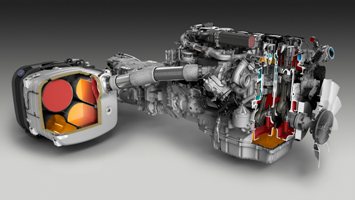
Cut away of Scania's 13-litre Euro 6 powertrain with integrated silencer and exhaust after-treatment